
Corruption: Part 1: The Monetization of Power
How proximity to political authority quietly reshapes markets, regulation, and public trust

American democracy rarely collapses in dramatic fashion.
More often, it erodes quietly — through proximity between political power and private profit.
This series examines how financial entanglement, selective enforcement, and cultural normalization can slowly reshape institutions without formally breaking them.
Part I begins with money.
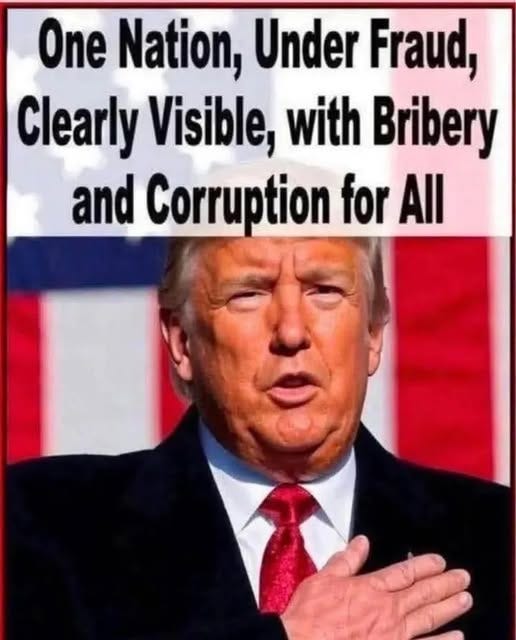
Cryptocurrency currently sits at the center of this evolution.
Trump publicly champions digital assets. Regulatory agencies soften or abandon enforcement. Prosecutorial priorities drift away quietly. Business optimism surges; they salivate knowing what’s coming. Meanwhile, Trump and his cohorts align with crypto ventures positioned to benefit from “friendlier oversight” and broader adoption.
Individually, none of these moves suspends the Constitution.
Collectively, they create proximity.
A pro-business administration is not inherently corrupt. But when the industries receiving deregulation are the same industries linked financially to the president’s family and inner circle, the distinction between ideological governance and personal gain becomes difficult to maintain.
The issue is not whether crypto should exist.
The issue is whether a president can demand regulatory shifts in a sector where his own network and family stands to benefit financially without weakening public trust in neutral rule-making.
Free markets are one thing.
Free adjacency to federal power is another.
Manipulated markets ruin free markets and the whole point of capitalism.
When regulatory discretion aligns with personal proximity, even absent proven illegality, institutional confidence erodes. I work in the banking industry, and every year I take numerous courses designed to raise awareness about ethics and legalities, and even the appearance of self-dealing is addressed.
It matters in banking and it matters in a democracy because public trust in both is foundational.
Free markets are one thing. Free adjacency to federal power is another.
Foreign Sovereign Wealth and Deferred Gratitude
Consider the post-White House trajectory of the feckless, feeble Jared Kushner.
After serving as an unqualified senior adviser deeply involved in Middle East diplomacy, Kushner launched Affinity Partners and secured billions in commitments from the Saudi Public Investment Fund and other Gulf investors.
Defenders argue this reflects confidence in his expertise.
That may be true.
But the rest of us see corruption! It wouldn’t be allowed in my industry!
When a senior official shapes foreign policy toward a region and later receives extraordinary financial backing from the sovereign wealth of that same region, the optics alone scream corruption.
Even if no explicit quid pro quo exists, the incentive structure shifts.
Future policymakers observing this sequence must learn a lesson:
Diplomatic proximity can mature into private opportunity.
We know Authoritarian systems thrive on precisely this kind of soft patronage. Loyalty and favorable policy are not rewarded with envelopes.
They are rewarded with access, capital, and partnership once formal office ends. (In this case, they are not waiting for formal office to end.)
Even if it should be, it does not have to be illegal to be corrosive.
The American system was designed with the assumption that public service would not double as business development. When that assumption weakens or is outright exploited, foreign policy credibility weakens with it.
Deregulation as Leverage
Regulatory agencies are meant to function as counterweights, as watchdogs - not as instruments of personal advantage.
This is impossible if the agents are handpicked specifically for their loose ethics and values.
When enforcement softens toward politically connected industries while maintaining or increasing pressure elsewhere, rule of law becomes conditional.
It doesn’t take long before other industries learn what they must do to play the game under Trump.
If crypto firms aligned with political networks experience leniency while adversarial actors face aggressive scrutiny, the message is not subtle.
Proximity matters. Loyalty pays.
Selective enforcement is like oxygen for a fire for authoritarianism.
A republic can survive policy disagreement.
It struggles to survive conditional enforcement.
Equal justice under law loses to greed every time in administrations that require pay-for-play.
A republic can survive policy disagreement. It struggles to survive conditional enforcement.
The Reframing of Conflict
Perhaps the most consequential shift is cultural.
Conflicts of interest that would once have ended careers are now reframed as savvy entrepreneurship. Financial entanglement is presented as competence. Critics are dismissed as anti-growth or partisan.
Now, open corruption is no big deal.
Corruption is no longer denied.
It is rebranded.
The Trump administration’s ability to fuse branding, governance, and monetization becomes evidence of dominance. Strength is measured not by restraint, but by how much ethical elasticity one can exercise without consequence.
That cultural adaptation is what makes institutional erosion possible.
We clearly see that laws alone do not protect democracies.
Expectations do.
When the public gets used to leaders maintaining active, personal financial ecosystems tied to policy outcomes, the cost of self-dealing drops.
And when the cost drops, the practice spreads.
Future leaders do not need to break new ground; they can simply slide in to start profiting right away!
They simply inherit a looser system and learn how to exploit it for themselves.
Architect and Accelerator
To be fair, Trump did not invent political conflicts of interest.
He did something far more consequential.
He normalized them at scale.
From the start, even in his first term, he rejected traditional firewalls between public office and private enterprise. Properties remained active. Branding continued. Business ventures expanded into sectors directly affected by federal policy.
He tested how much overlap the system would tolerate.
The answer, repeatedly, was more than expected.
That lesson alters incentive structures for everyone who follows. If ethical guardrails bend without breaking, they invite additional pressure.
Authoritarian systems do not arrive fully formed.
They emerge when ambition encounters insufficient constraint.
When financial entanglement meets minimal consequence.
When loyalty shields leaders from meaningful institutional correction.
We are not living under suspended elections or shuttered courts.
We are living in a moment where the monetization of power feels increasingly routine.
That is the warning.
Democracies rarely recognize proximity to the line in real time. They adjust gradually. They rationalize incrementally.
They discover, often too late, that what once felt unthinkable now feels ordinary.
In Part II
In Part II, we leave financial markets and move to enforcement power.
We will examine how immigration policy, private detention contracting, and patterns of regulatory asymmetry deepen a system in which loyalty and monetization reinforce one another.
If Part I traces the fusion of money and governance, Part II will examine what happens when that fusion extends into:
who gets detained
who gets contracts
and who faces the full weight of federal power
The line is not abstract.
It is administrative.
And it is closer than it looks.